The almond pages on this site include listings of almond nurseries, growers, sales as well as industry overviews, propagation information, almond products and a range of other almond related information.
Although almonds have been cultivated since ancient times in northern India and across the middle east to Turkey, the U.S. is the world's primary producer of almonds, most of which are grown in California.
In Australia, almonds have been cultivated since the 1950's and 60's but only recently have they been grown in significant numbers. In the late 1990s around 4,000 hectares were planted with almonds, today around 27,000 hectares are under cultivation nationally. The primary commercial areas are located in south-eastern Australia and include the Willunga, Barossa Valley and Riverland areas of South Australia as well as the Riverina in New South Wales and the Sunraysia region. The Sunraysia region accounts for nearly three quarters of Australia's production.
The Australian almond industry is one of the fastest growing in the world.
Crop levels were 10,000 tonnes in 2002. The 2011 harvest is expected to increase 18.3 percent over the previous year to 45,400 tonnes. The Australian almond industry is currently valued at $250 million of which 63% is exported and 37% comprises the local market. Overseas sales are expected to top $100 million for the first time.
In 2015 kernal production is expected to increase to 85,000 tons and the industry valued at $500 million. This will position Australia as the world’s second largest producer of almonds – behind California. (Source - Almond Board of Australia)
India is the largest export market currently importing around 40 per cent of Australia's almonds. - (Source - Almond Board of Australia)
Although Australia's share of the world market is only 3%, it is currently 3rd largest producer after California and Spain. Australia's almond export industry has a good growth potential as over 95% of world production is in the Northern Hemisphere. In 3 years Australia will be the second largest almond producer, producing between 6% - 8% of the worlds crop.
The almond industry began in South Australia but almonds are now also grown extensively in Victoria and New South Wales. Current plantings total around 27,300 hectares of which of which 68% are located in Victoria, 20% in South Australia and 12% in New South Wales.
Most commonly grown varieties are Nonpareil Californian Paper Shell) (51%), Carmel (32%), Price (12%), Peerless and others (5%). These are irrigated by drip irrigation (90%), sprinklers (9%), other (1%)
Almond Board of Australia (ABA)
As the Australian almond industry's peak industry body, the ABA facilitates further growth of the industry. The ABA seeks to maximise industry profitability and ensure its sustainability, by providing a platform for industry members to collectively respond to industry wide issues, to invest in research and marketing, share knowledge, and interact with government and other stakeholders. Access the website of the Almond Board of Australia for more information.
Right - Almond Blossom - Courtesy of the Almond Board of Australia
Cultivation
In cooler climates almonds can be successfully grown if the site is warm and protected from cold wind. For the garden choose a smaller self- fertile variety. Compact size trees are easier to net against birds. A nursery specialising in nut trees should be able to provide you with advice on suitable varieties.
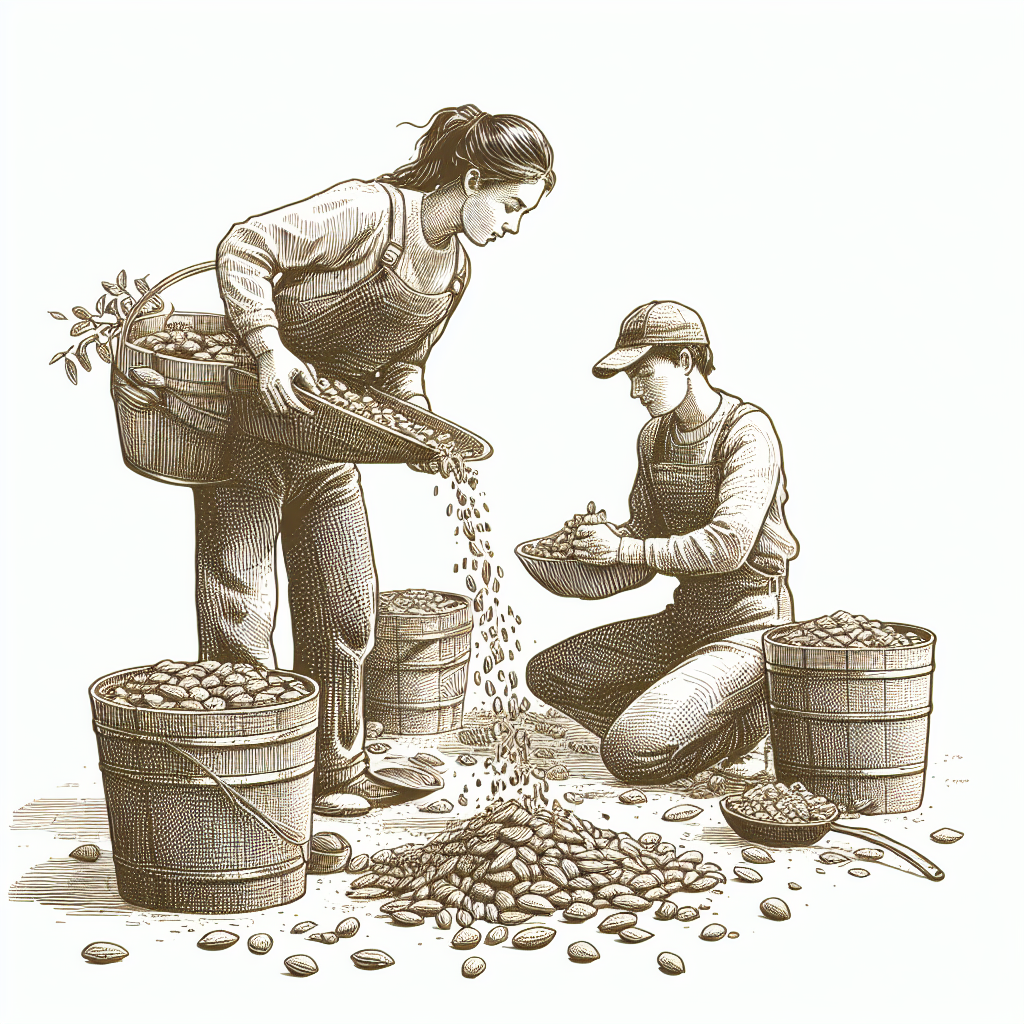
Harvesting is usually undertaken in February and March. The traditional method is by knocking the almond nuts off by hand and collecting them. Larger plantations use mechanical pickers. Green almonds are available from late October into November.
VarietiesHealth and Nutrition
Almonds are great for vitamin E. 20 nuts (a handful 30g aprox) provides 85% of the recommended daily intake for Vitamin E. See the Health- Almond page for more details. See also the Almond Products and the Almond Recipes pages.